


About tooth decay
Tooth decay is a disease in which decay-causing bacteria in plaque produce acid that dissolves the tooth. Early decay can sometimes heal with brushing, but once it has progressed past a certain point it only gets worse. It won’t heal if you leave it alone. To keep your teeth for many years, have decay treated, if possible, while the nerve can still be saved.
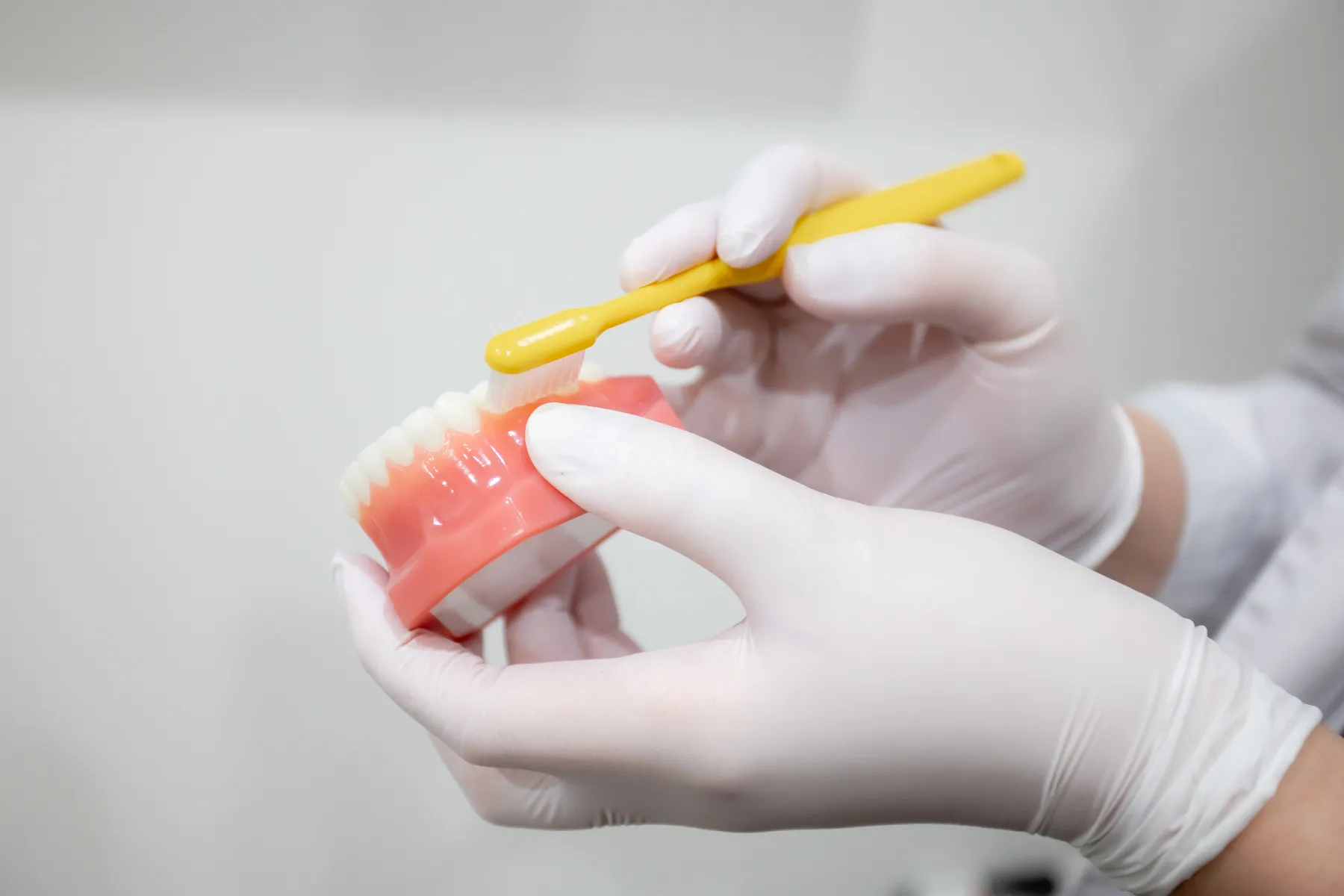
Symptoms of tooth decay
In the early stage of tooth decay, the tooth surface dissolves, loses its shine and turns light brown, but there are no symptoms you would notice. As acid from the bacteria dissolves the enamel on the surface, that area may change color or develop a hole, and the tooth may be sensitive, but there is little pain at this stage.
If the decay goes unnoticed, it eventually reaches the dentin and the nerve, causing severe pain even without any stimulus. The pain can keep you awake and disrupt daily life, so this is the stage at which many patients first come in. By this point, however, the decay is well advanced and is unlikely to heal on its own, so we drill out the decay and fill the tooth, or treat the nerve.
If the decay is left even longer, the pain may stop for a while, but pus collects at the root of the tooth or in the gum, causing even more severe pain, and in the worst case the tooth has to be extracted.
Causes of tooth decay
There are four main causes of tooth decay.
-
Bacteria in the mouth
There are several hundred species of bacteria in the mouth, and the one responsible for tooth decay is called Streptococcus mutans.

-
Sugar in your diet
Bacteria in plaque use the sugar in your diet to produce acid, and this acid dissolves the calcium and phosphate in your teeth, causing decay.

-
Time
The longer sugar stays in the mouth, the more active the bacteria become, and the further the decay progresses.

-
Tooth quality
Tooth quality varies from person to person because of differences in how the teeth formed, heredity and other factors, and some people’s teeth are more prone to decay. These factors interact in complex ways to cause tooth decay.

Stages of tooth decay
Tooth decay is classified into five stages, from CO to C4, according to how far it has progressed.
C0
CO is the earliest stage of tooth decay. It’s the stage before a hole forms: the surface has lost its shine and looks cloudy, or has turned light brown. At this stage, fluoride treatment at the dentist and daily brushing can keep it from progressing, so it’s often monitored rather than treated.
C1
At C1, a small hole has formed in the enamel. At this point there is almost no pain or other symptom, so decay often progresses unnoticed. Treatment at this stage involves removing the decay and filling the tooth.
C2
At C2, the decay has spread into the dentin under the enamel and formed a larger hole. Because it’s close to the nerve, cold or sweet things may cause sensitivity, and you may feel pain. Treatment involves removing the decay and then, depending on its condition and size, placing a filling or a crown.
C3
At C3, the decay has reached the nerve. It causes severe, throbbing pain even without any stimulus, which can keep you awake and disrupt daily life. It becomes difficult to treat with a filling, so the nerve is removed and the tooth is fitted with a crown. Treatment therefore tends to take more visits and a longer time.
C4
C4 is the most serious stage. The decay has reached the root, inflammation has spread to the bone that supports the tooth and the surrounding gums, and the risk of decay in other teeth is very high, so in many cases the tooth has to be extracted. When the nerve dies, the severe pain may stop for a while, but if pus collects at the root or the infection reaches the bone, it causes even worse pain and strong bad breath.
Treatment process
Step1.
Appointment
First, please make an appointment. You can book by phone or online.
Step2.
Examination
We check how far the decay has progressed using dental instruments and X-rays.
Step3.
Explaining the treatment plan
We explain the condition of the decay and go over the treatment plan with you.
Step4.
Removing the decay
We remove the decayed tissue. If the infection has reached the nerve, we also treat the nerve.
Step5.
Fitting a filling or crown
Depending on how far the decay has progressed and its size, we fit a filling or a crown.
Step6.
Treatment complete
We also provide maintenance to keep the treated area clean.
Treatment costs
The first-visit fee is around ¥4,000 (30% co-payment). After that, the cost varies with how far the decay has progressed and what treatment is needed.
Early stage
¥1,500–3,000
(approx.)(30% co-payment)
Moderate cases
¥2,000–10,000
(approx.)(30% co-payment)
If you choose a self-pay material such as ceramic for the filling or crown, this is charged separately.
Severe cases
¥7,000–30,000
(approx.)(30% co-payment)
If you choose self-pay treatment such as a ceramic crown or a dental implant, this is charged separately.
About insurance coverage
Treatment for tooth decay falls into two types: “insured treatment”, covered by health insurance, and “self-pay treatment”, paid in full out of pocket. Basic treatment is covered by health insurance, so depending on your coverage, most patients pay 30% of the cost.
However, insured treatment is limited to the minimum needed to relieve pain and restore function, using methods and materials approved under the insurance system. If you want better aesthetics, function, durability or a lower risk of decay, we recommend self-pay treatment.
Examples of insured treatment
Procedures such as removing decay, nerve treatment and extractions, and materials such as silver fillings, silver crowns and insurance-approved dentures
Examples of self-pay treatment
Ceramic fillings, ceramic crowns, dental implants, metal-based dentures and clasp-free dentures
Preventing tooth decay
To prevent tooth decay, it’s very important to deal properly with each of its causes: bacteria in the mouth, sugar in your diet, the passage of time, and tooth quality.
-
Make a habit of brushing your teeth soon after eating.
-
Use floss, interdental brushes and mouthwash to remove what your toothbrush misses.
-
Avoid eating over long stretches of time, and cut back on snacks as much as you can.
-
Have regular checkups at the dental clinic, and strengthen the enamel with fluoride treatment.
-
Avoid mouth-to-mouth feeding and similar habits so you don’t pass decay-causing bacteria to babies and young children.
Our dental technician

Naohiko Nagasaka
Graduated from the Dental Technician Training School, Aichi Gakuin University School of Dentistry
1986: Joined Kyoshin Shiken in Chuo-ku, Tokyo
After working as a part-time lecturer, joined Cosmetic Ceramics in New Jersey, USA in 1991
After returning to Japan, opened Techno Ceramics in Shinagawa-ku, Tokyo in 1996 (now based in Kawaguchi City)