


Survey on attitudes toward “tooth alignment and orthodontic treatment”
When asked, “Do you think tooth alignment affects first impressions?” 20.4% answered “yes” and 52.2% answered “somewhat.”
In total, 72.6% of people felt that tooth alignment matters to a first impression.
The impression made by attractive teeth
People say that straight or crooked teeth change the impression you give, but how much of a difference do they make?
In a 2009 survey on tooth alignment and orthodontic treatment by the Japanese Association of Orthodontists, as many as 72.6% of people answered that “tooth alignment affects first impressions.”
- Looks clean
79% - Healthy
78% - Elegant
62% - Well brought up
54%
Three things about your teeth that make you look beautiful
-
White teeth
As the expression “bright eyes and white teeth” suggests, a beautiful person is described as having clear, beautiful eyes and pure white teeth. In psychology, too, people are said to associate white teeth with qualities such as “youth, cleanliness and intelligence.” Whitening can give you white teeth.
-
A beautiful E-line
Seen in profile, the line from the tip of the nose to the tip of the chin is called the “E-line” (aesthetic line). The lips are considered ideal when they touch this line or sit just inside it. Correct tooth alignment and bite are essential to achieving this E-line.
-
A beautiful smile line
The “smile line” is the line along the edges of your teeth when you smile. A well-shaped smile line makes for a beautiful smile. Salespeople who make a good impression on customers in stores have one thing in common: a beautiful U-shaped smile line, with both corners of the mouth turned up. Check yours in the mirror.
Source: Fashion HR
“Outer beauty starts with beautiful teeth!”
https://fashion-hr.com/hr-talks/hr-talks_real/12663/
A conversation on cosmetic dentistry at Hamille
-
Hamille staff
I’ve heard teeth play a big part in first impressions. Is that true?
Kosei Akasaki – Chairman, Hamille Tokyo Ogawamachi
Teeth are everything for us humans.
-
Hamille staff
What do you mean, teeth are everything…?
Kosei Akasaki – Chairman, Hamille Tokyo Ogawamachi
The Japanese Association of Orthodontists surveyed 1,000 men and women in their teens through 50s about “tooth alignment and orthodontic treatment.”
When asked, “Do you think tooth alignment affects first impressions?” 20.4% answered “yes” and 52.2% answered “somewhat,” meaning that 72.6% in total felt tooth alignment matters to a first impression. -
Hamille staff
So 72.6% of people feel that tooth alignment matters!
Kosei Akasaki – Chairman, Hamille Tokyo Ogawamachi
Another survey, on how people form impressions of others, found that 70% of people consider the face most important in a first impression, and that, for the mouth, more than 40% find well-aligned teeth appealing.
Along with alignment, tooth color is also a very important factor. More than 20% of people said they find white teeth appealing. As you can see, problems with your teeth have a very large effect on the impression you make. -
Hamille staff
So nice teeth make a huge difference to how people see you!
Kosei Akasaki – Chairman, Hamille Tokyo Ogawamachi
In developed countries in particular, being judged by your teeth is taken for granted, so many people from other countries have nice teeth. Being Japanese alone often makes a very good impression, so let’s all pay attention to our smiles and avoid coming across as sloppy!
The frightening truth about metal restorations…
-
Rare in developed countries?
Treating decay with silver crownsIn Western countries, beautiful white teeth and good tooth alignment are regarded as very valuable, and have even become a sign of social status. Dirty teeth can hurt your job prospects and give the impression that you don’t take care of yourself, to the point of affecting your sales performance at work. For that reason, many people pay close attention to keeping their teeth beautiful and healthy.
It’s also said that in Western countries, 98% of people go to the dentist for prevention and teeth cleaning, and 2% go for treatment. In Japan, however, a full 98% of people go to the dentist for treatment. It’s sad to hear people say, “Japanese girls are so cute, so why are their teeth dirty when they smile?” -
Dangers of silver restorations made from
a gold, silver and palladium alloyOnce decay is treated with a silver restoration, you end up with another one every time you get a new cavity. Fillings and crowns made of other materials are often self-pay, so if you mainly get insured treatment, it is not unusual to end up with a mouth full of silver restorations.
What is called a “silver restoration” in Japan is made of a gold, silver and palladium alloy and exists only in Japan. It was developed for the universal health insurance system as a cheap, easy-to-shape silver restoration that restores minimum tooth function, but in recent years its harmful effects have been drawing attention. Below, we explain the three risks people are concerned about.
Risks of silver restorations
-
Can cause metal allergies
Besides the tens of billions of bacteria living in the mouth, silver restorations face a harsh environment every day: hot food, cold food and biting force. As a result, they are prone to deterioration and damage. Metal ions can dissolve from the surface of a silver restoration and bind with proteins in the body, which can cause a metal allergy.
Palladium, one of the metals in silver restorations, is especially likely to cause allergies, and about 20 to 30 in 100 people are said to be allergic to it. -
A crowned tooth can decay again
A silver restoration is attached to the tooth with dental cement, but to be precise, they are not tightly bonded. When the restoration is placed, cement fills the gap between it and the tooth, and only the friction between the cement and the restoration holds it in place.
As a result, it is not unusual for decay-causing bacteria to get in and for decay to spread again underneath. The cement also deteriorates over time, so it is common to find that the tooth under an old silver restoration has turned black. Decay under a silver restoration is also hard to see and does not show up well on X-rays, so it is hard to detect. -
Periodontal disease is more likely to worsen
The surface of a silver restoration is prone to scratches, and bacteria in the mouth gather in large numbers in those tiny scratches. Periodontal bacteria and many other bacteria also tend to collect where the silver restoration meets the gum, and periodontal disease may progress faster after a silver restoration is placed. Some of you may have had your gums swell, or teeth loosen from periodontal disease, a few years after getting a silver restoration on a back tooth.
Debris and bacteria tend to build up around silver restorations in particular, so besides a toothbrush, you need to use interdental brushes and floss to keep your teeth clean, and have regular checkups and cleanings at a dental clinic. When the area where the silver restoration meets the gum becomes home to bacteria, it can also cause bad breath.
A dental clinic in Kanda-Ogawamachi and Ochanomizu | Hamille Tokyo Ogawamachi
Cosmetic dentistry cases
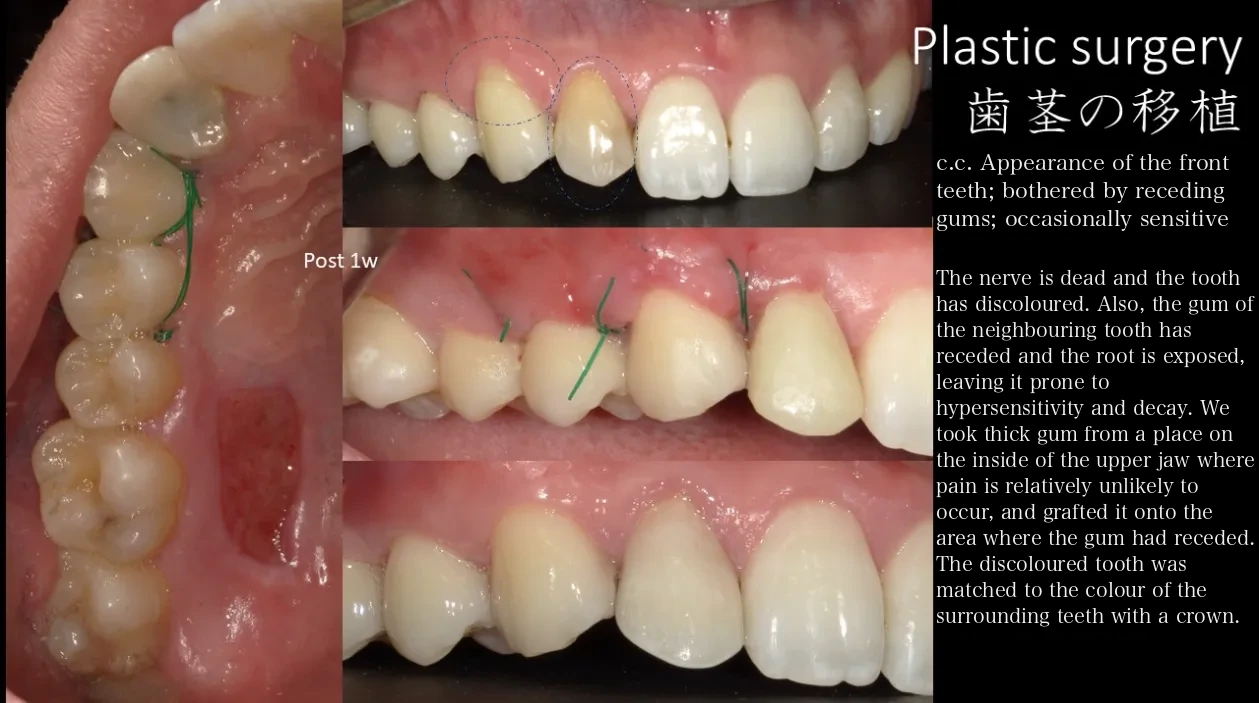
Cosmetic dentistry case 1: Gum graft
Chief complaint: Appearance of the front teeth; bothered by receding gums; sometimes sensitive
The nerve is dead and the tooth has discolored. The gum on the neighboring tooth has also receded, exposing the root, which makes it prone to hypersensitivity and decay.
We took thick gum tissue from an area on the palate that tends to cause less pain and grafted it onto the area where the gum had receded. The discolored tooth was given a crown to match the color of the surrounding teeth.
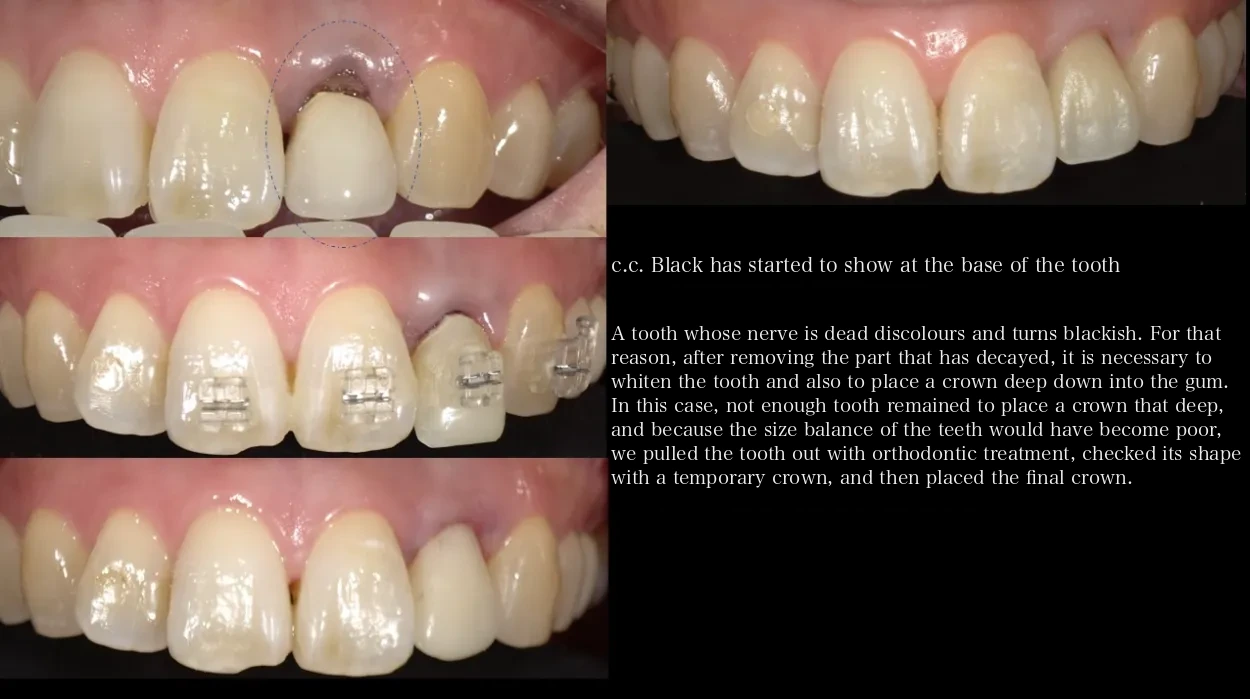
Cosmetic dentistry case 2
Chief complaint: Something dark has started to show at the base of the tooth
A tooth with a dead nerve discolors and darkens. So after the decayed part is removed, the tooth needs to be whitened and a crown placed that extends deep below the gum. In this case, not enough tooth was left to place a crown that deep, and the teeth would have looked uneven in size, so we used orthodontic treatment to pull the tooth further out, checked its shape with a temporary crown, and then placed the final crown.
What is 1-day ceramic (CEREC)?
Using the latest CEREC computer system, we make ceramic restorations (fillings and crowns) at a comparatively low price, and the whole process from making to fitting can take as little as 1 hour!
Who it’s for
- Too busy to visit
the dentist many times - Want to replace silver restorations with white ones
- Want to keep costs down
- Want to improve tooth
alignment and shape
Features and benefits of 1-day ceramic (CEREC)
Ceramic treatment is completed in as little as 1 hour
Less prone to decay
Less prone to wear and discoloration, with no worry about metal allergies
You can choose the color and shape
Impressions are also taken with a scanner, so it’s not unpleasant
Even teeth that didn’t respond to whitening can be made white
Very short treatment time
Primescan: bringing out new possibilities
Primescan, creating the next generation of digital dentistry. It makes workflows more efficient at the chairside and with digital labs and outside partners, and delivers even greater accuracy, scanning speed and ease of operation. – Enjoy the scan.
For me, Primescan changed the standard for dental scanning. For my team as well as for me, intraoral scanning has become more accurate, faster and easier than ever before*. It’s easy for anyone to use and intuitive to operate. It slots straight into our workflow, and the treatment process becomes far more comfortable. Its advanced technology lets us capture more high-resolution data than before, process it fast, and get high accuracy and sharpness. It handles everything from single crowns to full-arch treatment. With much better connectivity, working with digital labs and outside partners is simple.
– Enjoy the Scan!
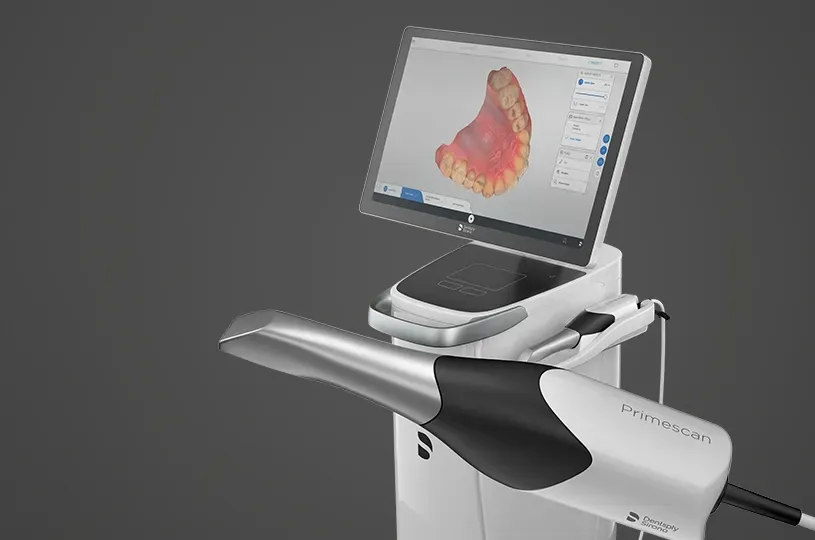
Features of Primescan
-
Accuracy
Proprietary “Smart Pixel Sensor” and “Dynamic Depth Scan” technologies produce more lifelike, sharper 3D data
-
Smooth workflow
Works with digital labs and outside partners, and with a chairside milling unit added, also supports “One Visit Treatment” (treatment in a single visit)
-
Ease of operation
Its wide, efficient glass window can scan hard-to-reach areas such as the last molars, as well as glossy materials. A built-in self-heating function lets it scan inside the mouth without the camera fogging up
-
Speed
It takes only the essential core data from the huge volume captured, for faster, optimized processing
-
High mobility
A movable wide touchscreen and touchpad make it intuitive to use. Battery power makes it mobile, and it’s designed for ease of use around the clinic
-
Versatility and future potential
CEREC solutions cover the three main fields of restoration, implants and orthodontics, supporting chairside and clinic-to-clinic workflows. Get ready for the future with CEREC.
Our dental technician

Naohiko Nagasaka
Graduated from the Dental Technician Training School, Aichi Gakuin University School of Dentistry
1986: Joined Kyoshin Shiken in Chuo-ku, Tokyo
After working as a part-time lecturer, joined Cosmetic Ceramics in New Jersey, USA in 1991
After returning to Japan, opened Techno Ceramics in Shinagawa-ku, Tokyo in 1996 (now based in Kawaguchi City)