


Periodontal regeneration
Until now, treatment could only stop periodontal disease from progressing. Now it can restore what was lost.
Are you doing everything you can to keep periodontal disease from progressing so you don’t lose your teeth? At our clinic, we may be able to get your mouth back to its original healthy state.
What is periodontal disease? For details, see here
Is periodontal disease incurable?
Periodontal disease was once called an “incurable disease,” but advances in periodontal treatment have since made it possible to stop it from progressing. However, there is a limit. Treatment can control the inflammation, restore a healthy state and keep the disease from progressing any further, but it cannot restore things like receded gums.
A. Bone that’s been lost won’t return to its original state
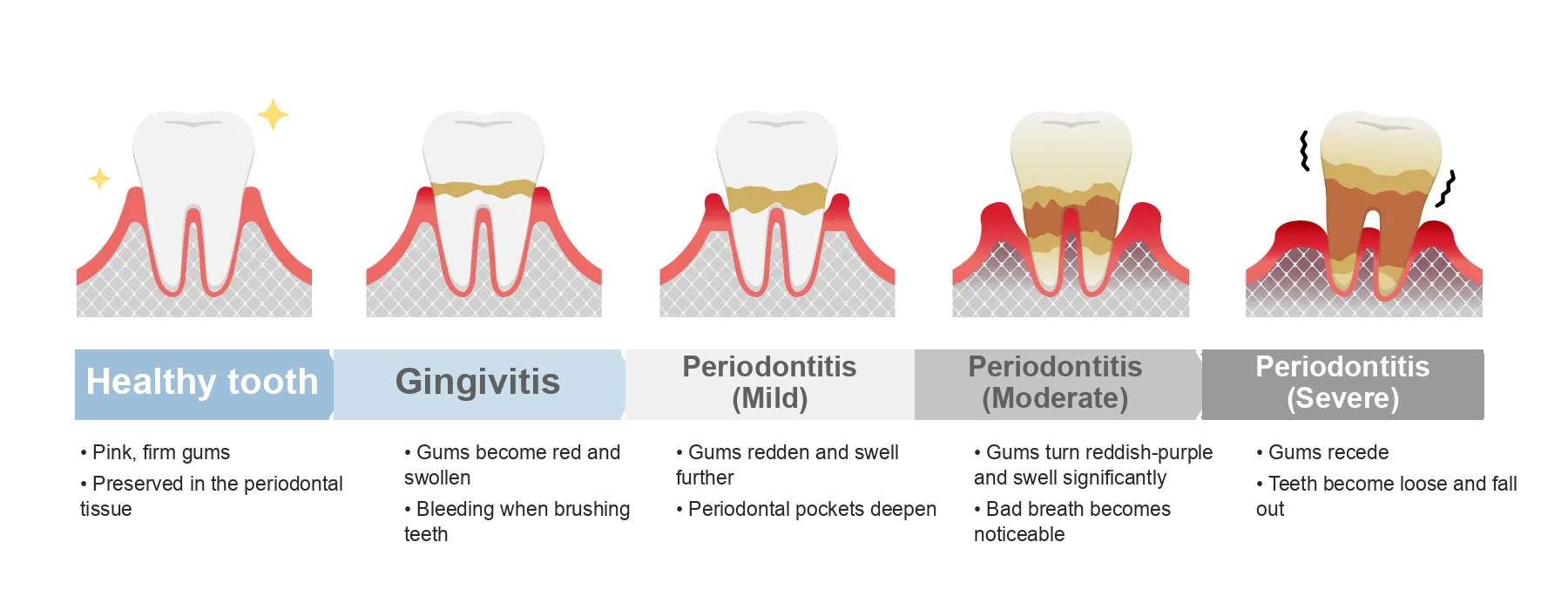
The option of “regeneration.”
In recent years, periodontal treatment has advanced further, from “stopping” the disease to making “regeneration” possible. The latest “periodontal regeneration treatment” can regenerate destroyed tissue and return teeth as close as possible to their original healthy state.
If periodontal disease is a concern for you, whether you’ve been diagnosed with it, have been told a tooth needs to be extracted because of it, or want to improve receding gums, please talk to Hamille. At our clinic, we may be able to get your mouth back to its original healthy state.
Options that can add ten years to the life of your teeth.
Treatment using Emdogain (EMDG method)
Inflammation has spread deep into the gums and destroyed the periodontal tissue (bone has been lost, gums have receded). ⇒ Periodontal surgery using Emdogain can regenerate and restore the lost tissue.
What is Emdogain?
Emdogain is a type of periodontal regeneration therapy that regenerates periodontal tissue lost to periodontal disease, such as the bone that supports the teeth (alveolar bone) and the periodontal ligament.
Applying a type of protein to the root surface creates an environment similar to when a tooth first grows in, which promotes regeneration of the periodontal tissue. It is used in over 40 countries and has been shown to have a high level of safety. It was approved by the Ministry of Health, Labour and Welfare in 2002 and designated as advanced medical care in 2007.
- Indications for Emdogain
- ○ Vertical bone defect: only the bone around a particular tooth has a vertical dip.
○ Furcation involvement: the periodontal tissue has broken down as far as the point where the roots divide.
○ Gum recession: the gums have receded, making tooth decay and periodontal disease more likely.
A dental clinic in Kanda-Ogawamachi and Ochanomizu | Hamille Tokyo Ogawamachi
Treatment process
Incision
We numb the area and make an incision in the gum at the treatment site.
Removal
We remove plaque and tartar from the root surface.
Application
We apply Emdogain gel to the area where bone has been lost.
Suturing
We suture the incision, and the treatment is complete.
Treatment using GTR (guided tissue regeneration)
There are two common types of periodontal regeneration therapy: GTR and Emdogain.
Years of research have shown no significant difference in effectiveness between them, but GTR requires a high level of skill for correct placement of the resorbable membrane and carries a risk of infection, for example if the membrane becomes exposed.
* Emdogain is now the more widely used method, and because of the risks, our clinic does not offer GTR.
About Bio-Oss
Inflammation has spread deep into the gums and destroyed the periodontal tissue (bone has been lost, gums have receded). ⇒ Periodontal surgery using Bio-Oss, a bone graft material that replaces the lost tissue.
What is Bio-Oss?
A bone graft material for areas where the amount or thickness of bone is insufficient. It’s mainly used with Emdogain in the GTR method, to build up bone to a level where implant surgery is possible.
Bio-Oss is a bone graft material of natural bovine origin. It’s used around the world because it bonds well with the human body and has a low risk of infection. Its safety and efficacy were approved by the Ministry of Health, Labour and Welfare in 2011.
- Indications for Bio-Oss
- ○ Vertical bone defect: only the bone around a particular tooth has a vertical dip.
○ Furcation involvement: the periodontal tissue has broken down as far as the point where the roots divide.
A dental clinic in Kanda-Ogawamachi and Ochanomizu | Hamille Tokyo Ogawamachi
Treatment process
Incision
We numb the area and make an incision in the gum at the treatment site.
Removal
We remove plaque and tartar from the root surface.
Application
We apply Emdogain gel to the area where bone has been lost and fill it with Bio-Oss.
Suturing
We suture the incision, and the treatment is complete.
Treatment using CTG (connective tissue grafting)
Connective tissue is one of the three layers of the gums (epithelial tissue, connective tissue and periosteum). CTG is periodontal surgery that grafts tissue from another site onto areas where the gum has sunk in and tissue is lacking because of gum recession, root exposure and similar problems. It restores both appearance and function.
- Indications for CTG
- ○ Vertical bone defect: only the bone around a particular tooth has a vertical dip.
○ Gum recession: the gums have receded, making tooth decay and periodontal disease more likely.
A dental clinic in Kanda-Ogawamachi and Ochanomizu | Hamille Tokyo Ogawamachi
Treatment process
Incision
We numb the area and make an incision in the gum at the treatment site.
Harvesting
We remove connective tissue from the palate (upper jaw).
Grafting
We graft the connective tissue onto the sunken area.
Suturing
We suture the incision in the upper jaw and the grafted area, and the treatment is complete.
A dental clinic in Kanda-Ogawamachi and Ochanomizu | Hamille Tokyo Ogawamachi
Treating a gummy smile
A gummy smile, where the gums show when you smile, is a condition similar to gum recession. This treatment is also effective for people who feel self-conscious because their gums look large.
What causes a gummy smile?
The causes vary: bone structure, tooth alignment, the muscles around the mouth, the size of the gums and teeth, and more.
○ Muscle-related – the upper lip muscles are strong, so the upper lip rises too far.
○ Bone-related – the upper jaw is large, or the lower jaw is smaller than normal
○ Tooth-related – the teeth are short and positioned low.
- Risks of leaving a gummy smile untreated
- ○ Self-consciousness: you worry about how you look and hold back your smile. You keep your mouth closed in every photo.
○ Tooth decay and periodontal disease: it affects the bite and tooth alignment, making tooth decay and periodontal disease more likely.
○ Bad breath: the mouth is hard to close, so it dries out, which tends to cause bad breath.
A dental clinic in Kanda-Ogawamachi and Ochanomizu | Hamille Tokyo Ogawamachi
Gummy smile treatment
Treatment needs to match the cause.
-
Teeth that are too small
Options include gingivectomy and crown lengthening.
-
Teeth positioned too low and too far forward
Options include crown lengthening surgery.
-
The upper lip rises too far
Options include LIP (upper lip mucosal excision) and botulinum toxin injections.
-
Tooth alignment
Options include orthodontic treatment and clear aligners.
Before you lose your teeth to periodontal disease,
talk to your nearest Hamille about periodontal regeneration treatment!